

While this project remains largely focused on Amazon, for our next two articles we are focusing on another logistics giant, Walmart. Before Amazon revolutionized logistics for e-commerce, Walmart did the same for retail with its lean warehousing and supply chain system. Walmart remains one of Amazon’s main competitors internationally and in Canada. In these articles we will be analyzing Walmart Canada’s unique logistics network, Unifor’s growing campaign to organize Walmart Canada’s logistics workers and the significance of Walmart’s responses to these efforts. We believe these events have major lessons for logistics sector organizing that we intend to draw out in our analysis. Special thanks to On the Seams for creating the maps referenced in this article.
In September 2024 over 800 workers at the Walmart Regional Distribution Centre (RDC) in Mississauga made history by unionizing with Unifor. This successful card certification, which was part of Unifor’s sector-wide Warehouse Workers Unite campaign, made them the first unionized Walmart location in all of North America. Unifor followed this with successful union certifications for 96 Walmart fleet drivers in Surrey, BC in November and 280 drivers in Nisku, Alberta in February. While a new obstacle was placed in Unifor’s way when Walmart sold their entire fleet to the third party fleet provider, Canada Cartage, and the Mississauga workers remain in contract negotiations, these successes are a notable advance for labour organizing. As the world’s largest employer and one of Canada’s biggest retailers, Walmart is an essential target for the labour movement in Canada. Unifor’s campaign in Mississauga marked a shift away from previous high-profile union campaigns in Canada and the U.S. that have focused on organizing retail workers. While retail workers make up the majority of Walmart’s workforce they do not occupy the same strategic role in Walmart’s supply chain as warehouse workers. This gives warehouse workers more leverage to disrupt company operations and therefore more ability to challenge Walmart’s control over their supply chain.
This is especially true in Canada because of the unique qualities of their national distribution network. In order to adapt Walmart’s business strategy to a more sparsely populated country Walmart Canada, which is a section of Walmart International, created a national distribution network that is highly centralized compared to its U.S. counterpart. Fourteen of Walmart Canada’s sixteen warehouses can be divided into three geographically dense clusters located in the Greater Toronto Area (GTA), the small town of Cornwall, Ontario and the Calgary Metropolitan region. These three regions supply the majority of merchandise to Walmart Canada’s 408 stores along with their growing nation-wide direct to customer e-commerce business. In contrast, Walmart’s distribution network in the U.S. is divided into 42 less centralized warehouse clusters that serve surrounding stores in a 125 mile radius. This makes Walmart warehouse workers in Canada uniquely positioned to win major victories against the company because they can disrupt an entire nation-wide distribution network by organizing just three densely clustered geographical regions.
Below, we will breakdown each of these three major regions by their different warehouses types, square footage and employee numbers that exist within each cluster. This will not only help us understand more about how Walmart Canada has organized its warehouse network to fuel its supply chains, but also point to strategic possibilities for workers to exercise power within it.
GTA Region
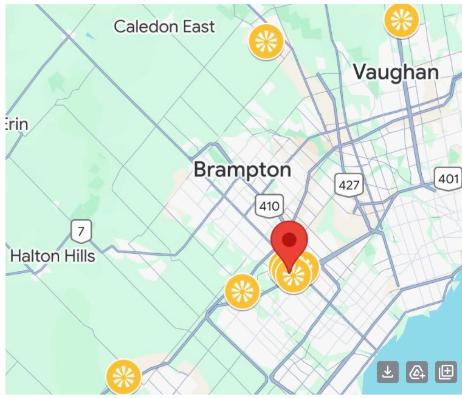
The largest of these warehouse clusters in terms of number of centres is in the GTA region (in map above). The majority of this cluster is in Mississauga. The recently unionized centre is likely the biggest in the region since it is a Regional Distribution Centre (RDC). Canadian RDC’s, like their U.S. counterparts, are large warehouses that sell general merchandise, dry grocery and occasionally fulfill e-commerce orders. They tend to be the most economically significant warehouse in a cluster that also has food, online fulfillment and other types of distribution centres. Most articles on the unionization campaign last year say it has 800 workers, but UNIFOR organizer Angela Drew Kimeoman places it at closer to 900 workers.
This unionized RDC is within 2.6 km of three other centres. One is a Walmart High Velocity Distribution Centre (HVDC). This centre type supplies dry groceries and other high velocity items like toiletries and cleaning supplies. The other two buildings are online Fulfillment Centre’s (FC’s) that are operated by a 3PL company called SCI logistics and play an important role in Walmart Canada’s attempts to expand the e-commerce side of its business. The larger centre is a 450000 sq. ft and fulfills direct-to-customer orders across Canada. The fifth warehouse in Mississauga is a Perishable Food Distribution Centre (PFDC) that is 8km west of the RDC.
In Vaughan a 550000 sq. ft Distribution Centre (DC) has recently opened. This centre has been described by Walmart as their most advanced facility in Canada with high automation and robotics capabilities. While MWPVL says that US DC’s differ from RDC’s due to their more specialized inventory, the Vaughan DC is listed as supplying general merchandise and dry grocery like most RDC’s do. This seems to imply that Canadian DC’s are sometimes less specialized and play a similar multi-purpose role to the larger RDC’s. Walmart has also described the Vaughan centre as a major part of their expansion plans for e-commerce. A 2024 article from The Logic similarly says it is part of Walmart’s plan to compete with Amazon in online order fulfillment. This implies it fulfills online orders directly to customers which, if true, reinforces the Vaughan DC’s centrality in Walmart’s plans to compete for Canadian market share against logistics competitors. Its strategic significance to Walmart Canada’s business strategy, along with its high capital investment, make it a potentially key location for workers to exercise power over the company’s supply chain.
We believe this cluster (that also includes DC’s in Milton and Bolton) supplies the vast majority of Ontario’s 148 stores. The only other Ontario cluster (that I will describe below) is primarily focused on supplying Quebec and Eastern Canada along with a few Ontario stores East of Kingston Ontario. This means that GTA warehouses supply nearly 36% of Canada’s Walmart stores and, through the SCI logistics operated FC’s and the new Vaughan DC, a meaningful portion of their Canada wide e-commerce business. With RDC’s typically being the biggest and most important building in a Walmart logistics cluster, Walmart Canada likely sees Unifor’s recent unionization campaign as a real potential challenge to their control over their national logistics network.
Cornwall
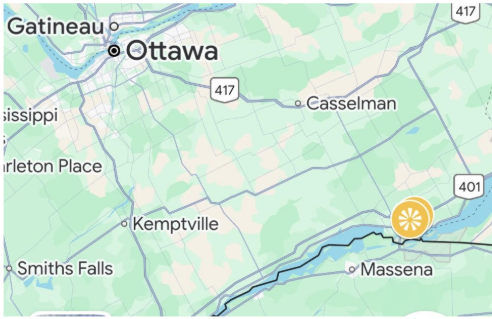
This is compounded by the fact that Unifor is in the process of trying to organize the two warehouses in Cornwall (see above). These warehouses supply all stores starting in Kingston, Ontario and extending to the Atlantic provinces. This includes 72 Quebec stores and non-perishable inventory for 39 stores divided across New Brunswick, Nova Scotia, P.E.I. and Newfoundland/Labrador. The Cornwall centres were responsible for supplying all Eastern Canadian inventory before the 2023 opening of a PFDC in New Brunswick.
Cornwall’s RDC is 1.36 Million square feet and is reported as having 750 workers as of 2022. It supplied Walmart stores while being operated by a 3PL company called Supply Chain Management (SCM) until 2014. It was then purchased by Walmart and eventually renamed as an RDC. This is consistent with Walmart’s continent wide approach of integrating most of their warehouses under company control. The Cornwall cluster is unique, however, because it has only two warehouse buildings and the RDC is the smaller of the two.
The massive Harmony building, which opened in 2017, is subdivided into three centres: an Import Distribution Centre (IDC), an HVDC and a PFDC. The building is often reported to be 1.5 million sq. ft or 1.8 million sq ft. depending on whether office space is included in the measurement. Unifor president Lana Payne said in a January interview that the building has 1500 workers. She also said Unifor has been in the process of talking to those workers about a unionization campaign since late last year. As Walmart Canada’s largest warehouse in terms of square footage and number of workers, along with the multi-purpose role it plays in supplying different aspects of their business, a successful union campaign at this location would be of great strategic significance.
Calgary Metropolitan Area
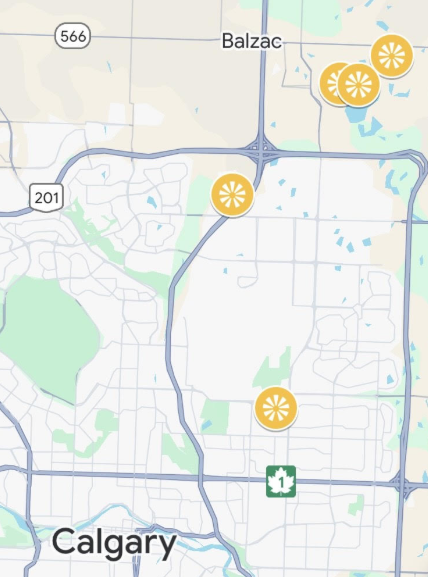
The other major logistics cluster is in the Calgary area and consists of five centres (see above.) In Calgary proper there is an RDC and another DC. Last year they began piloting new automation and robotics technologies at the RDC such as Autonomous Mobile Robots (AMRs). Just north of Calgary there is a HVDC in Balzac and a PFDC and FC in the neighbouring suburb Rocky View. The Rocky View FC was described at its launch as Walmart Canada’s first high-tech FC. It is 430000 square feet, employs 325 people and is capable of shipping 20 million units annually. The construction of this centre along with the piloting of new robot technologies at the RDC make this regional cluster significant to Walmart Canada’s national plan to spread new automation technologies across their warehouse network.
While the FC serves as the distribution hub for online orders in Western Canada, the rest of the cluster supplies the majority of Western Canada’s stores. They were responsible for supplying all inventory items in the 48 BC stores until a PFDC was built in Surrey, B.C. three years ago to supply wet grocery items. They continue to supply BC stores with other inventory along with the 61 Alberta stores. It is likely they also supply the 32 stores evenly split across Saskatchewan and Manitoba since they are in closer proximity than the GTA warehouses.
Considerations for organizing
The heavy dependence of Walmart Canada’s entire distribution network on a small number of densely clustered warehouses with 7000 workers make it an appealing target. This high centralization and relatively smaller worker numbers could allow for faster victories compared to Amazon’s larger logistics network or the many failed attempts to organize Walmart retail workers. A successful campaign to organize a meaningful number of Walmart Canada’s warehouses could also create momentum for Amazon warehouse and Walmart retail organizing campaigns. The success of Unifor’s election in Mississauga, that seems to have carried into the beginnings of a Cornwall organizing campaign, makes this possibility seem more within reach.
In the wake of Amazon’s closure of their warehouse network in Quebec, some in the labour movement could be concerned that the relatively small size of Walmart Canada’s warehouse network could create easier flexibility to close warehouses and move to third-party suppliers. While this would reverse a trend of Walmart in North America to further integrate its warehouses under Walmart control, the operating of two of their FC’s in the GTA by a third-party company shows they do trust a meaningful part of their business to a 3PL provider. Walmart Canada’s selling of their entire delivery fleet to Canada Cartage in response to driver certification campaigns, along with their closure of a unionized Quebec store in 2005, shows they are willing to use site closures and third party logistics companies as a counter to union organizing. However, Warehouses are much bigger investments than their delivery fleet or a single store and closing or selling them would take far more consideration.
This would also come with much higher costs for Walmart compared to Amazon’s decisions to close their warehouses in Quebec. Due to Amazon’s much smaller investments in Quebec warehouses compared to other regions, they supplied a much smaller percentage of Amazon Canada’s total market than any of the three major warehouse clusters described above do for Walmart Canada. The high amount of capital investment into each Walmart warehouse cluster in Canada and their strategic significance to Walmart Canada’s supply chain will make major closures or reorganizations of their warehouse network quite costly.
As Walmart’s logistics network has moved away from third-party suppliers they have also added increasing automated technology to their warehouses. The labour and logistics blog On The Seams describes the rapid automation of US RDC’s and other centres, with investment in highly advanced forms of automated palletizing, as a major component of Walmart’s competitive strategy. While Walmart centres in Canada have developed these capabilities slower than their US counterparts, they are introducing them in several locations. This includes the new Vaughan DC, the Calgary RDC and the nearby Rocky View FC. Walmart Canada has said they aim to spread this technology across warehouses in other regions over the next four years. However, as detailed by a study by the Berkeley Labor Centre about trends in warehousing from 2020-23, 3PL’s tend to be less likely to invest in automation due to their reliance on unstable short-term contracts, split focus across several clients and lower access to capital. The high capital investment in already automated centres, and the need to further develop its automation capabilities to compete with Amazon, Loblaws and other retail giants, could disincentivize Walmart Canada from countering union organizing by switching to third-party suppliers.
This is also the case for the possibility of supplying Walmart stores and customers from across the U.S. border. There is a low density of Walmart warehouses in the U.S. near the Canadian border and each of those centres are already responsible for supplying U.S. Walmart stores in their 125 mile cluster. Canada’s Distribution Centre’s are set up to supply stores and customers across large distances at competitive speeds. It is unlikely U.S. centre’s could make up for lost capacity if Walmart decided to close a unionized Canadian centre, especially centres with high strategic significance to their supply chain. If they attempted to do so they would significantly undermine their ability to supply surrounding American stores and customers which would hurt their U.S. business. Since Walmart’s distribution infrastructures are designed uniquely for each country, attempting to use non-unionized U.S. Walmart warehouses to undermine unionized warehouse workers in Canada could end up lessening Walmart’s competitive edge in both countries.
The combination of recent organizing successes at Walmart Canada, along with the structural vulnerability of its distribution network to a small number of regionalized worker organizing campaigns, makes the struggle to unionize Walmart Canada one with huge potential power. A string of further victories could inspire future organizing efforts across the larger warehousing and logistics sector of Canada’s economy while emboldening the labour movement in Canada more broadly. They could also add Canada to the list of countries where Walmart workers have gained real victories against the company. Organizing success for Walmart workers here would also be uniquely significant due our close proximity to the U.S., where organizing momentum could spill over the border and embolden U.S. Walmart workers to challenge the world’s largest employer on their home turf.

One response
Nice article but SCI doesn’t run the 2 e-commerce sites in Mississauga. It’s fully run by Walmart employees for at least 5 years now