
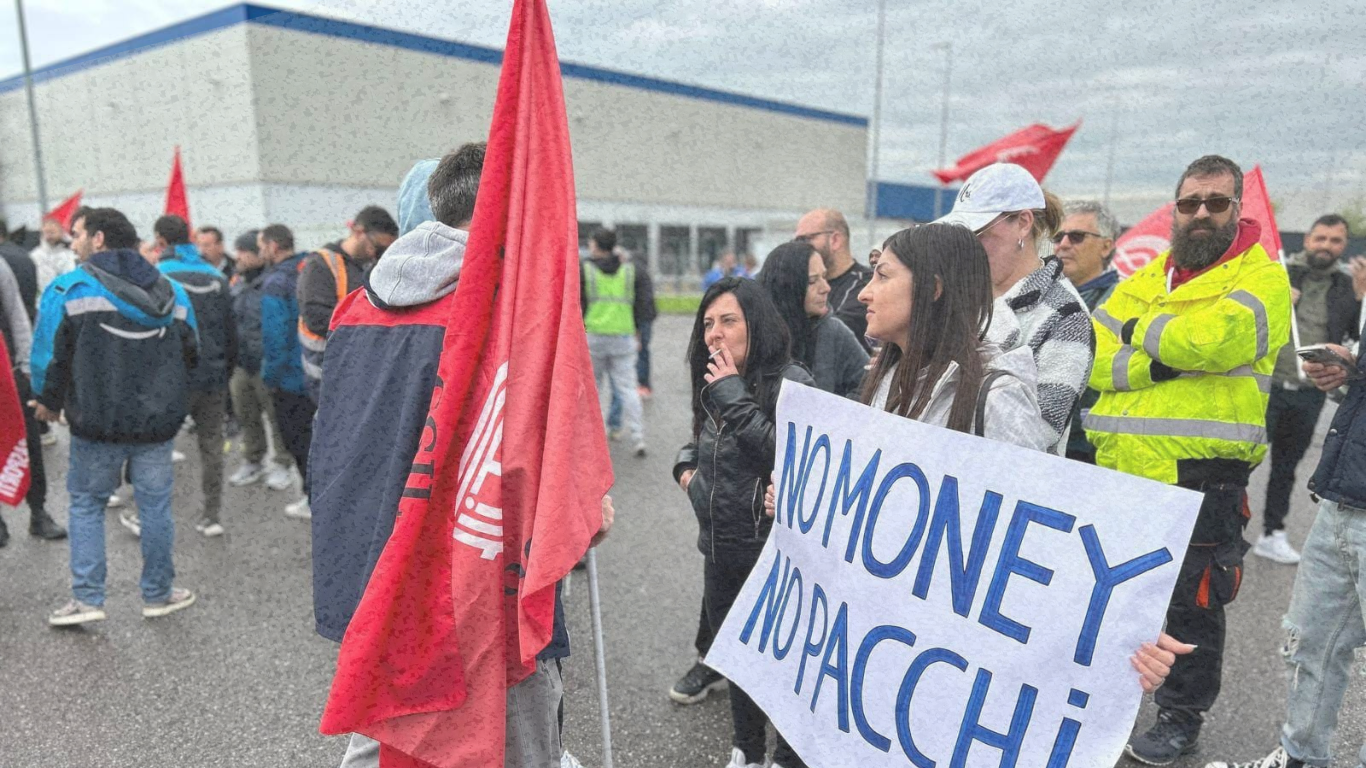
Translation of sign in photo: “No money, no packages”.
On April 18, across Italy, more than 10,000 Amazon delivery drivers went on strike, halting the company’s last-mile deliveries to demand better wages and improved working conditions.
The conditions that led to the strike were alarming. One driver shared:
“In Bologna, there have been days when the roads were completely flooded… and yet we’re still asked to deliver packages in near impossible driving conditions…”
Frustrated by dangerous working conditions, constant speed-ups, and mounting workloads, workers shut down 41 delivery stations for 24 hours. The strike, which saw over 85% participation among the 15,000 Amazon delivery drivers across Italy, was led by the three union federations organizing Amazon in the country: CGIL, CISL, and UIL.
For several years, one of the key demands drivers have brought forward is to be officially recognized as Amazon employees. That’s right — you can spend hours delivering Amazon packages under grueling conditions, but the company still refuses to call you their employee.
This is because the company subcontracts its last-mile delivery operations in Italy to many different smaller enterprises, gathered under Assoespressi; a national corporate association in Italy with more than 100 companies operating in last mile distribution and e-commerce.
Through subcontracting to third-party logistics (3PL) providers like Assoespressi, Amazon maintains tight control over its last-mile delivery network while distancing itself from direct accountability for workers’ rights, wages, and safety. Globally, this layered system allows Amazon and similar corporations to impose exploitative labor conditions, sideline unionization efforts, and avoid taking full responsibility for their workforce. In the USA, Amazon continues to avoid accountability to its delivery drivers as an employer.
Despite Amazon’s subcontracting model, their heavy reliance on temporary agency workers, and the company’s reluctance to negotiate or respect sectoral standards, workers in Italy have once again shown that building towards a majority and disrupting operations can bring Amazon and its 3PL corporate allies to the bargaining table.
After walking off the job in April, workers originally planned another 48-hour strike in June. Fearing another disruption, Amazon and Assoespressi vowed to present an offer to the unions, leading to the strike being called off.
In July, an agreement was reached with 90% of workers voting in favour. The agreement introduced higher pay, performance bonuses, cancellation of deliveries during extreme weather events, a higher number of permanent full-time contracts and more (see “Details of July 2025 Second-Level Agreement” below).
The stakes are high, and this could mark a crucial victory for the global movement to unionize Amazon. While many workers voted in favour, there were also groups who remained skeptical of Amazon/Assoespressi’s terms and called on the unions to struggle for a better agreement.
Through a supply chain strike at every facility (from first mile to last mile) and the constant threat of work stoppages, Amazon workers in Italy secured a collective bargaining protocol in September 2021 that included warehouse workers and drivers. This protocol established the right to negotiate over issues such as safety, training, scheduling, and performance bonuses, all aligned with national sectoral standards. Importantly, the agreement extended beyond direct Amazon employees to include subcontracted drivers, temporary workers hired through staffing agencies, and independent contractors (i.e. flex delivery model).
True to form, Amazon quickly began undermining its workforce and eroded the agreement, which was not sufficiently strong to begin with. As conditions deteriorated once again, frustration among workers ultimately sparked the renewed wave of strike threats we’re seeing today.
Workers know they must keep Amazon on its toes. The company has a well-documented history of backtracking and attacking workers’ rights to workplace safety. This is also why the majority of Amazon drivers in Bologna voted against the agreement signed in July, highlighting its weaknesses and demanding better terms. Workers of different companies in Italy have also raised concerns on the three unions (CGIL-CSIL-UIL) active at Amazon, stating that they’ve been pushed into signing compromised agreements presented as ultimatums. Undoubtedly, the struggle against a corporation of Amazon’s scale will be protracted.
Building permanent forms of shop-floor organization and long-term struggle may prove more decisive than relying on isolated choke points or episodic strikes that deliver only short-term concessions. Given the regional and transnational integration of Amazon’s fulfillment network, there is potential to build power for logistics workers through sheer numbers all across the supply chains.
Amazon has played a strong role in deteriorating working conditions for the logistics sector globally. Governments cozy up with Amazon and further enable its industry practices, proudly financing the company’s attack on the working class through tax subsidies paid for by the people. It is on our horizon to question Amazon’s relationship with the state apparatus that enables its dominance.
Canada?
Unlike Italy, strikes in Canada are regulated by the law, leaving the door wide open for state intervention against unions in favour of corporations.
What happens when you unionize one delivery company in Canada? In Toronto, back in 2017-2018, workers attempted to unionize a third-party logistics company delivering for Amazon. After 75% of the workforce signed union cards, the subcontractor abruptly shut down operations, declared bankruptcy, and left.
They’ll tell you that they can no longer afford Amazon’s contracts and need to shut down. In the 3PL subcontracting world, it’s the same story: rinse and repeat. And yet, 3PL companies are crucial for Amazon and other large retailers to run their operations.
Never mind subcontracted companies. In Quebec, Amazon took one look at the union in Laval and bolted faster than a Prime delivery. When forced into negotiations, they vanished like a missing package. Instead, they gave a contract to Intelcom/Dragonfly to maintain Amazon’s operations in the province.
Whether it’s Amazon or its 3PL allies, nothing stops them from walking away or shutting down operations. That’s the power they wield and the constant threat they rely on to undermine and ignore their workers’ collective bargaining. But we can’t defeat ourselves by thinking that organizing the behemoth fulfillment centres or subcontracted 3PL companies is impossible. For us, the fight goes beyond signing union cards or striking a single workplace — it’s about building lasting power across the sector.
This means building permanent power on the shop floor, where workers assert an alternative authority to the managers who constantly undermine their health and safety. This kind of power can’t stay isolated; it needs to grow and coordinate across workplaces, regions, and the entire industry.
If Amazon aims to dominate society, then our ambitions must reach further. We need to stay two steps ahead.
Amazon reshapes the industries it enters, restructures local economies, and influences public policy wherever it operates. It pushes to rewrite labor law in its favour and sets the standards for the entire sector to follow. That’s why organizing Amazon and the broader sector is no longer just a strategic choice. It’s an existential responsibility for the labor movement worldwide that demands unity, struggle, and a shared vision for working-class power.
We want to give a special mention to Laura Montanari, member of the Transnational Social Strike Platform, for working with AWS on this article.
Details of July 2025 Second-Level Agreement:
- Increases in travel allowance and performance bonus: Travel allowance of approximately 20 euros per day. For deliveries outside the municipality of origin, a payment of 20.50 euros per day is expected (instead of 1.5 euros) starting from May 2025. This will gradually increase until June 1, 2027 and it will become 24 euros per day. For deliveries within the municipality of origin, the travel allowance will start from 16.50 euros per day in May 2025 and rise to 21.40 euros by June 1, 2027.
- Performance bonuses that increase if there is no vehicle damage, amounting to around 1,200 euros per year for 2025, rising to 1,300 euros in 2026 and 2027.
- Shortening working hours: weekly working hours will go from 42 to 41 hours, meaning a daily cut of 12 minutes of work a day (a regular full time in Italy is 40 hours per week). Bringing the daily working time from 8 hours and 24 minutes (plus half an hour unpaid lunch break) down to 8 hours and 12 minutes per day. This reduction will be implemented starting from July 2027 (the agreement will expire on April 30, 2028).
- Cancellation of deliveries in case of floods or excessive heat waves (red alerts, quite common especially in recent years in Emilia-Romagna and also Tuscany, with frequent floods. Drivers were still working even when the city was flooded, it is not an exaggeration to say they were putting their lives at risk). With a weather alert, now drivers should stop.
- Semi-holidays become voluntary (in case of low workload).
- “Flexibility” criteria are introduced in case of an unexpected drop in workload, with the employer having the option to request up to 3 days of vacation or leave.
- Routes cancelled at the last minute will still be paid.
- Stabilization (long-term contracts instead of precarious ones): full-time employee contracts that should grow to 65% of the total workforce. Currently 60% of the drivers have long-term contracts and this will increase by another 5 percent during the agreement’s term.
